


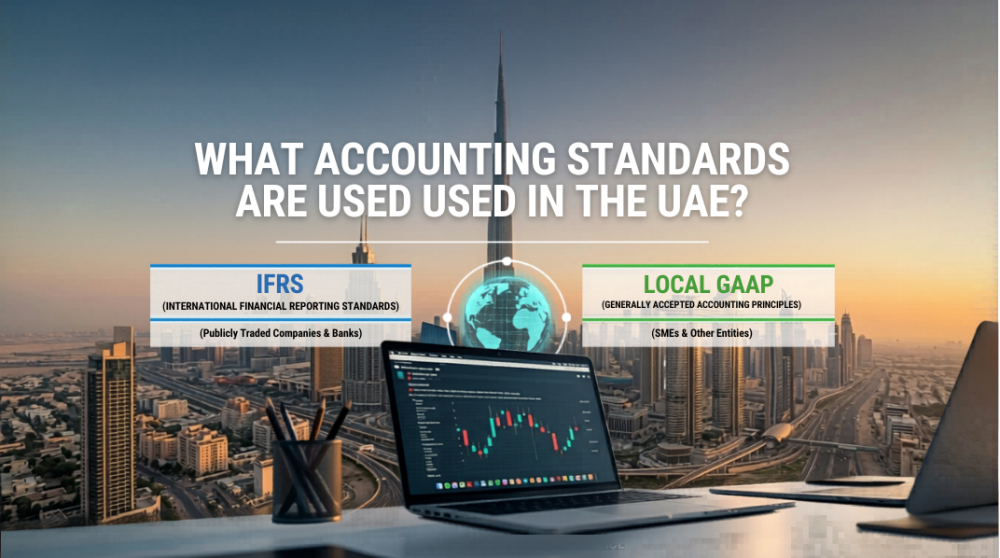
The United Arab Emirates (UAE) is known for its transparent, well-regulated, and business-friendly financial environment. Whether you are a startup, SME, or multinational company, following the correct accounting standards in the UAE is not optional—it is a legal and strategic necessity.
Overview of Accounting Standards in the UAE
The UAE does not have its own local accounting framework. Instead, it follows internationally recognized standards to ensure transparency, comparability, and investor confidence.
Primary Accounting Standard Used in the UAE: IFRS
The UAE officially follows International Financial Reporting Standards (IFRS) for preparing and presenting financial statements.
IFRS is issued by the International Accounting Standards Board (IASB) and is mandatory for most businesses operating in the UAE.
Types of Accounting Standards Used in the UAE?
- International Financial Reporting Standards (IFRS)Primary Standard
- IFRS for SMEs
- International Public Sector Accounting Standards (IPSAS)
- Financial Free Zone Regulations (DIFC & ADGM)
1. International Financial Reporting Standards (IFRS)
The UAE does not have its own "UAE GAAP" (Generally Accepted Accounting Principles). Instead, it has fully adopted IFRS as issued by the International Accounting Standards Board (IASB).
- Who uses it: All companies listed on the Dubai Financial Market (DFM) and the Abu Dhabi Securities Exchange (ADX), as well as large mainland and free zone entities.
- The Goal: To provide a global framework that makes financial statements consistent, transparent, and easily comparable for international investors.
- Key Components: It covers everything from revenue recognition and asset valuation to lease accounting (IFRS 16) and financial instruments (IFRS 9).
2. IFRS for SMEs
Recognizing that full IFRS can be administratively heavy for smaller shops, the UAE allows the use of IFRS for SMEs.
- The Difference: It is a self-contained standard (about 230 pages compared to the 3,000+ pages of full IFRS).
- Benefits: It omits topics not relevant to typical small businesses and significantly reduces the number of required disclosures, saving time and audit costs.
3. International Public Sector Accounting Standards (IPSAS)
While private companies look to IFRS, the UAE government has been migrating its federal and local departments toward IPSAS.
- Context: Traditionally, governments used "cash-basis" accounting (recording money only when it moves). IPSAS moves the public sector toward "accrual-basis" accounting.
- Impact: This provides a much clearer picture of the government’s long-term assets and liabilities, improving fiscal transparency.
4. Financial Free Zone Regulations (DIFC & ADGM)
The Dubai International Financial Centre (DIFC) and Abu Dhabi Global Market (ADGM) act as "independent jurisdictions" with their own civil and commercial laws.
- Strict Oversight: Both require entities to prepare accounts in accordance with IFRS.
- Regulatory Bodies: The DFSA (in DIFC) and the FSRA (in ADGM) act as the watchdogs, ensuring that firms—especially financial institutions—meet high-level international reporting benchmarks.
The Drivers: Why This Matters Now
Accounting in the UAE is no longer "optional" or just for internal use. Three major factors have made strict adherence to these standards a legal necessity:
| Factor | Impact on Accounting |
| Value Added Tax (VAT) | Requires accurate records of input/output tax based on IFRS-compliant revenue recognition. |
| Corporate Tax (9%) | As of 2023, the taxable income is generally derived from the accounting net profit shown in IFRS financial statements. |
| Economic Substance Regulations (ESR) | Requires companies to prove they have genuine operational "substance" in the UAE, backed by audited financials. |
Who Must Follow IFRS in the UAE?
IFRS is applicable to:
- Mainland companies
- Free Zone companies (unless a specific free zone allows exceptions)
- Companies registered under UAE Commercial Companies Law
- VAT-registered businesses
- Corporate Tax-registered entities
- Subsidiaries of international companies
Even small and medium-sized enterprises are expected to follow IFRS or IFRS for SMEs, depending on business size and structure.
IFRS for SMEs in the UAE
Small and medium-sized businesses in the UAE may apply IFRS for SMEs, a simplified version of full IFRS.
Key Benefits:
- Less complex reporting
- Lower compliance cost
- Easier financial statement preparation
- Still accepted by UAE authorities and banks
Professional accounting and bookkeeping services in Dubai help determine whether your business qualifies for IFRS for SMEs and ensure correct implementation.
Common IFRS Areas Affecting UAE Businesses
Some of the most important IFRS standards relevant in the UAE include:
- Revenue Recognition (IFRS 15)
- Lease Accounting (IFRS 16)
- Financial Instruments (IFRS 9)
- Inventory Valuation (IAS 2)
- Financial Statement Presentation (IAS 1)
Incorrect application of these standards can lead to penalties, audit issues, and financial misstatements.