


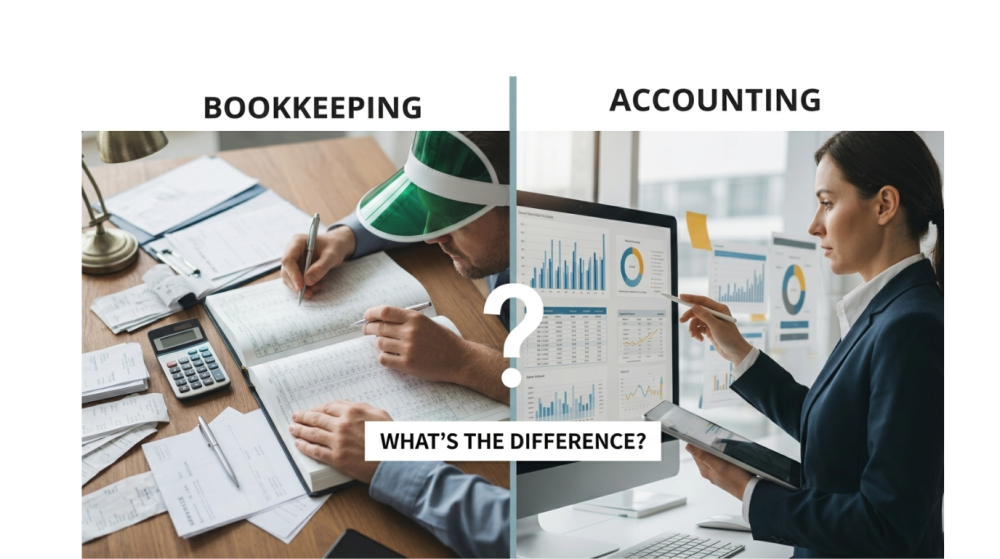
Two terms that get used interchangeably—but they're not the same thing. Here's what separates them and why it matters for your business.
If you've ever started a business — even a tiny one-person operation — you've probably had a moment where someone asked, "Do you have a bookkeeper or an accountant?" And if you're honest with yourself, you probably said one when you meant the other, or worse, assumed they were the same thing entirely.
You're not alone. These two roles are deeply connected, and in small businesses especially, the lines often blur. But bookkeeping and accounting are genuinely distinct disciplines — different in scope, in purpose, in skill level, and in what they actually do for your financial health. Understanding the difference isn't just academic. It can save you money, prevent legal trouble, and help you make smarter decisions about who you hire and when.
Let's pull them apart, clearly and practically.
Defining the Two Roles
What Is Bookkeeping?
Bookkeeping is the systematic process of recording financial transactions. Think of it as the daily maintenance of your financial records — the ongoing, methodical work of tracking every dollar that comes in and goes out. A bookkeeper records sales, expenses, payroll, invoices, and receipts into an organized ledger or accounting software. The work is largely transactional and repetitive by design.
In Plain English
A bookkeeper keeps the scoreboard updated. They make sure every financial event is logged accurately, consistently, and on time—so the numbers are always current and reliable.
Historically, this was done in literal books — hence the name. Today, bookkeepers typically work in software like QuickBooks, Zoho, or FreshBooks, but the underlying logic is the same: record, categorize, reconcile.
What Is Accounting?
Accounting is broader and more analytical. It takes the data that bookkeeping produces and transforms it into meaningful financial information. Accountants interpret records, prepare financial statements, identify trends, advise on tax strategy, ensure regulatory compliance, and help business owners understand what their numbers actually mean.
Where bookkeeping is about data capture, accounting is about data analysis. An accountant doesn't just want to know that you spent AED12,000 last month — they want to know whether that spending made sense, whether it was tax-deductible, and what it suggests about your cash flow going forward.
In Plain English
An accountant is a financial translator and strategist. They take the raw facts in your ledger and turn them into insights that help your business grow — or at least stay out of trouble.
Side-by-Side: The Key Differences
Here's a direct comparison across the dimensions that matter most. Keep in mind this is a general guide — real-world roles often overlap, especially in smaller organizations.
Dimension | Bookkeeping | Accounting |
| Primary focus | Recording transactions accurately | Analyzing & interpreting financial data |
| Nature of work | Routine, transactional, operational | Analytical, advisory, strategic |
| Output | Ledgers, journals, trial balances | Financial statements, reports, forecasts |
| Decision-making | Minimal; follows set procedures | High; involves professional judgment |
| Qualifications | Certificate or on-the-job training | Degree, CPA license, or equivalent |
| Tax involvement | Organizes data for tax prep | Prepares returns, advises on tax strategy |
| Business stage | Needed from day one | More critical as complexity grows |
| Typical cost | Lower (hourly or part-time) | Higher (CPA rates, especially at tax time) |
| Tools used | QuickBooks, Xero, spreadsheets | Same tools + financial modeling software |
What Each Role Actually Does Day-to-Day
| Bookkeeper's Daily Tasks | Accountant's Responsibilities |
|
|
One helpful way to think about it: if bookkeeping is the foundation, accounting is the architecture built on top of it. You can't have a sound financial picture without accurate records — but raw records alone don't tell you whether your business is thriving or quietly sinking.
How They Work Together
It would be a mistake to think of bookkeeping and accounting as competing functions. They're sequential. Bookkeeping feeds accounting. The quality of accounting work depends entirely on the quality of the bookkeeping that precedes it.
Garbage in, garbage out. If the books are a mess, no accountant — no matter how talented — can produce financial statements you can trust.
In practice, many businesses run both in parallel. A part-time bookkeeper handles weekly transaction entry and reconciliations, while a CPA or accounting firm is brought in quarterly or at year-end to review the books, prepare statements, and handle taxes. This division of labor is efficient and cost-effective — you're not paying CPA rates for data entry work.
In larger companies, both roles expand considerably. There may be entire bookkeeping teams managing different account categories, while a CFO and accounting department handle financial strategy, auditing, and compliance. But the relationship between the two functions remains the same.
Who Needs What — and When
The short answer: almost every business needs both, eventually. But timing and scale matter a lot.
Early-Stage Businesses (Freelancers, Sole Proprietors, Startups)
When you're just starting out, clean bookkeeping is your first and most important priority. You need to know what's coming in, what's going out, and whether your business model actually makes money. At this stage, you may do the bookkeeping yourself using software or hire a part-time bookkeeper.
You'll still want an accountant — even if only once a year — to file your taxes correctly and make sure you're not leaving deductions on the table. A one-time consultation can also save you from expensive structural mistakes early on.
Growing Businesses (Small to Mid-Size Companies)
As your business grows, the complexity of your finances grows with it. Payroll, inventory, contracts, loans, multiple revenue streams — suddenly your records are complicated enough that a dedicated bookkeeper isn't just helpful, it's essential. You also need more frequent accounting support: monthly or quarterly financial reviews, proper financial statements, and proactive tax planning.
Established Businesses and Corporations
At this level, you likely have in-house accounting staff and may require audited financial statements. The distinction between roles becomes formalized, with clear job titles, reporting structures, and regulatory requirements. Accountants here may specialize — in tax, in audit, in financial planning and analysis.
Quick Rule of Thumb
Start bookkeeping before you think you need it, and bring in an accountant before your first tax year is up. The earlier you build good financial habits, the less expensive it is to clean things up later.
Common Misconceptions Worth Clearing Up
- "My accountant handles the books too." — Maybe, but usually not. Most CPAs don't want to spend their time on data entry, and you'll pay dearly for the privilege if they do. Separate the roles when you can.
- "Bookkeeping software replaced bookkeepers." — Tools like QuickBooks help enormously, but they don't categorize expenses perfectly, catch duplicate entries, or reconcile accounts by themselves. Human oversight is still necessary.
- "I only need an accountant at tax time." — Tax season is the most visible moment, but good accountants add value all year: spotting inefficiencies, advising on purchases, forecasting cash needs, and helping you make decisions with confidence.
- "Bookkeepers can give financial advice." — Bookkeepers are skilled at recording and organizing, but they're generally not qualified to advise on tax strategy, interpret GAAP, or give professional financial opinions. That's accounting territory.
- "Small businesses don't need proper bookkeeping." — Actually, the opposite is often true. Smaller operations have less margin for error. A single misrecorded expense or overlooked invoice can cause real damage when you're running lean.
Making the Right Choice for Your Business
When you're deciding who to hire — or whether to outsource, use software, or do it yourself — here are the questions that actually matter:
- How many transactions does your business handle each month? If it's dozens, you can probably manage with software. If it's hundreds, a dedicated bookkeeper is worth it.
- How complicated are your finances? Multiple income sources, employees, loans, and inventory all add complexity that benefits from professional bookkeeping.
- What are your regulatory requirements? Some industries require audited statements. Some business structures have specific tax obligations. An accountant helps you understand these requirements before they become problems.
- Are you growing fast? Growth is exciting, but it creates financial complexity quickly. Don't let your bookkeeping lag behind your revenue.
- What decisions are you trying to make? If you want to know whether to take a loan, hire staff, or expand — you need an accountant's analytical view, not just a ledger.
For most small businesses, a practical starting point is part-time outsourced bookkeeping combined with a CPA relationship for tax and advisory work. As you scale, that shifts toward more dedicated internal or outsourced accounting support.